
Currently Empty: $0.00


Let's cut through the tech talk and get straight to what ohms actually mean for your vape. You've probably seen a number like 0.4Ω or 1.2Ω on a coil and wondered what it's all about. Think of 'ohm' as a way to measure electrical resistance. It’s the one thing that decides whether you get big, warm clouds or a cooler, more discreet puff.
Don't worry, you don't need an engineering degree to get this. It’s actually pretty simple.
Your Simple Guide To Vaping and Ohms
Understanding that little number on your coil is the key to unlocking the perfect vape experience. It controls everything from flavour intensity to cloud size. The best way to picture it is to think of electricity as water flowing through a garden hose.
The Water Hose Analogy
This simple comparison makes everything click. Imagine you're watering your garden:
- Low Ohms (e.g., <1.0Ω): This is like using a massive, wide-open fire hose. A huge amount of water (power) rushes through without anything holding it back. In vaping, this means your coil heats up incredibly fast, giving you those dense, warm clouds and a really intense burst of flavour. This is what's known as sub-ohm vaping.
- High Ohms (e.g., >1.0Ω): Now, imagine you’re pinching the hose. The path for the water (power) is much narrower, so the flow is restricted and controlled. For vapers, this translates to a cooler, less dense vapour—a sensation that often feels more like a traditional cigarette.
The lower the ohm number on your coil, the more power it will pull from your battery, creating more heat and vapour. The higher the number, the less power it pulls.
Once you grasp this simple trade-off, you're in complete control. You can pick coils that perfectly match your style, whether you're a cloud chaser or a flavour fanatic. Finding the right coils for your setup is easy in our online shop, and our fast vape delivery in Calgary ensures you get what you need without the wait.
To make these ideas even clearer, here’s a quick breakdown of how these concepts all tie together using our water hose analogy.
Vaping Concepts at a Glance
| Term | Water Hose Analogy | Role in Vaping |
|---|---|---|
| Voltage (Volts) | The water pressure in the hose. | The power pushed out by your battery. |
| Current (Amps) | The flow rate of the water. | The amount of electricity flowing through the coil. |
| Resistance (Ohms) | How much you pinch the hose. | Restricts the flow of power to the coil. |
| Power (Watts) | The total force of the water spray. | The final heat and vapour output you experience. |
This table shows how all the pieces work together. You don’t need to memorize the formulas, just remember the relationship: changing one thing affects everything else. It’s this balance that helps you customize every single puff.
How Ohm's Law Affects Your Vaping
Now that you have a grasp on what ohms mean in principle, let’s tie it directly to how your vape actually performs. It all comes down to a simple rule called Ohm's Law. Don't worry, this isn't a complex physics lesson. It's the fundamental relationship that governs how your device works, dictating everything from the heat of your coil to the density of your clouds.
Think back to our water hose analogy. Ohm's Law is the formula that connects all the pieces: Voltage (the water pressure), Current (the speed of the water), and Resistance (the pinch in the hose). In vaping, this means the power your battery sends out is directly controlled by your coil's resistance. A low-ohm coil lets a high current flow through, which translates to more power and more heat. It’s the cornerstone of how all electronics work, not just vapes.
The Power Triangle
It helps to think of it as a power triangle, where changing one element forces the others to adjust.
- Higher Resistance (e.g., a 1.2Ω Coil): This restricts the flow of current, leading to a cooler, smoother vape that sips battery power.
- Lower Resistance (e.g., a 0.4Ω Coil): This opens the floodgates, allowing much more current to flow. It demands more from your battery to produce that intense heat and massive vapour.
This simple diagram perfectly illustrates the difference between a low-ohm (wide path) and high-ohm (narrow path) setup.
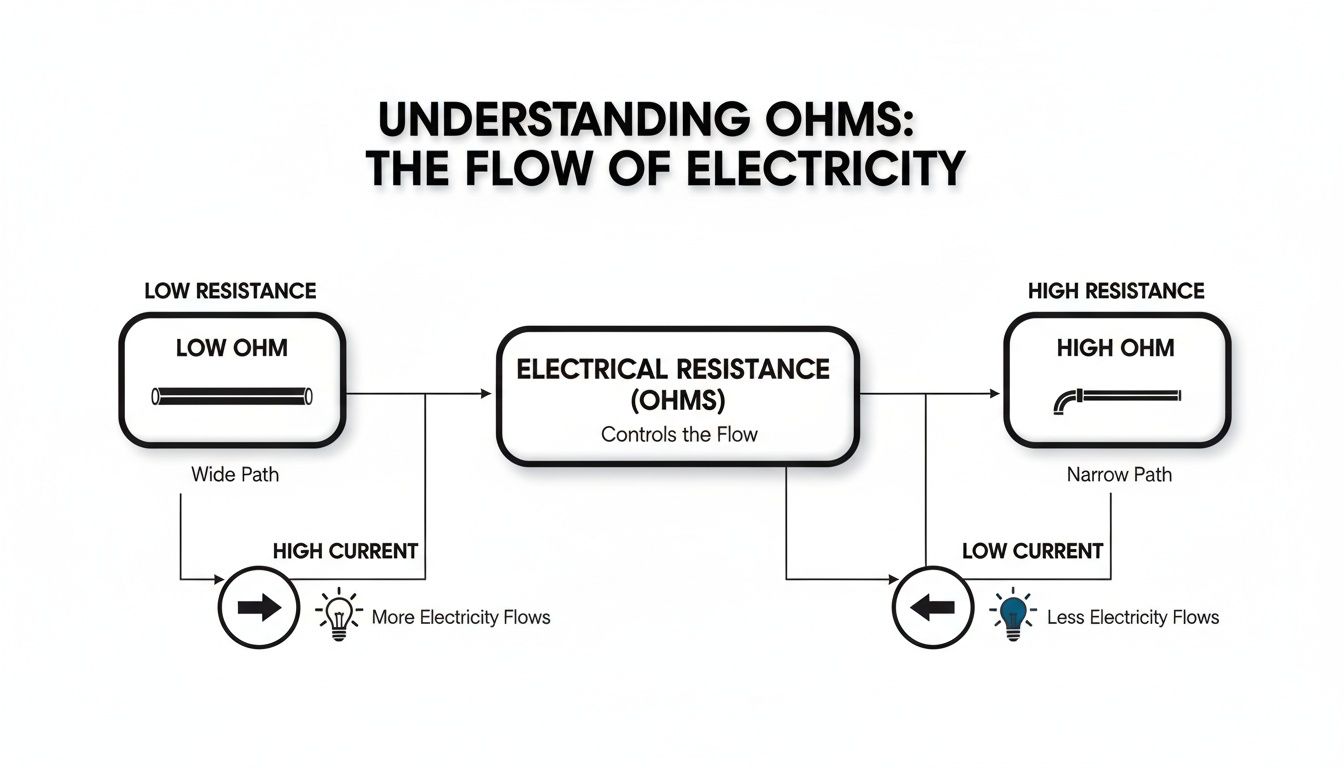
As you can see, lower resistance creates a wider lane for power to travel, resulting in a more intense experience.
Key Takeaway: You don't need to sit there with a calculator. Modern regulated vape mods do all the math for you in an instant to deliver the wattage you've selected. Still, understanding this relationship empowers you to make much smarter choices about your gear.
Getting a feel for this balance is how you graduate from using default settings to truly fine-tuning your vape for that perfect hit. It’s especially useful when you're browsing our online shop for new coils or tanks, ensuring you pick the ideal gear for your style and get it delivered right to your door in Calgary.
Choosing Between Sub-Ohm and High-Resistance Vaping
This is where the rubber meets the road. All that talk about ohms becomes practical when you realise your coil’s resistance directly shapes your vaping style. It really boils down to two main categories: sub-ohm (coils below 1.0 ohm) and high-resistance (coils above 1.0 ohm). Each one delivers a completely different experience.
Sub-ohm vaping is all about performance. Coils with low resistance, think 0.2Ω or 0.4Ω, let a huge amount of power flow through them, generating some serious heat. The result? Those massive, thick clouds of vapour you see, paired with a warm and intense direct-to-lung (DTL) inhale.
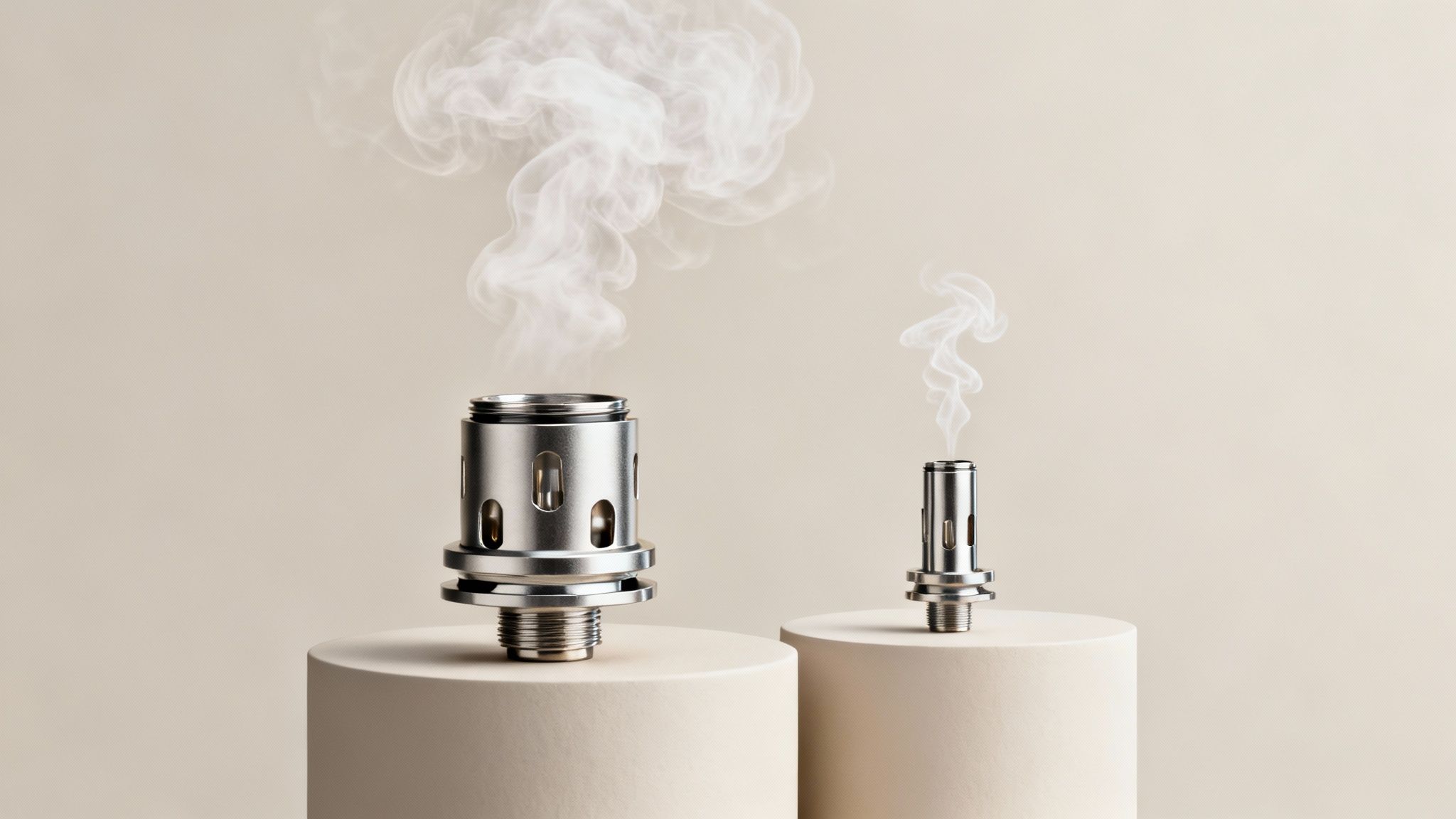
Sub-Ohm: The Cloud Chaser’s Choice
Think back to our "fire hose" analogy—that’s sub-ohm vaping in a nutshell. It’s a powerful and direct experience. Because of the high power draw, this style goes through e-liquid much faster and puts more strain on your battery, so expect to recharge more often. On the flip side, the flavour delivery is often described as richer and more robust.
This method works best with e-liquids that have a higher VG content. High VG helps produce those thick clouds and gives you a smoother hit at higher power. You can learn more in our guide to understanding the VG PG ratio.
High-Resistance: For the Flavour Seeker
On the other hand, high-resistance coils (anything over 1.0Ω) offer a more controlled, subtle experience. They restrict the electrical current, which means less vapour and a cooler temperature. This creates a tighter, mouth-to-lung (MTL) draw that feels a lot like smoking a traditional cigarette, making it a go-to for many people making the switch.
High-resistance vaping is generally more efficient. You’ll use less e-liquid and your battery will last a lot longer. It also tends to be fantastic at bringing out the more delicate and nuanced flavour notes in an e-liquid.
To make it even clearer, let's break down the key differences.
Sub-Ohm vs High-Resistance Coil Comparison
| Feature | Sub-Ohm (<1.0Ω) | High-Resistance (>1.0Ω) |
|---|---|---|
| Vapour Production | Massive, dense clouds | Discreet, smaller clouds |
| Inhale Style | Direct-to-Lung (DTL) | Mouth-to-Lung (MTL) |
| E-Liquid Consumption | High | Low |
| Battery Life | Shorter | Longer |
| Flavour Profile | Intense and warm | Nuanced and cool |
| Best For | Cloud chasers, warm vape lovers | Vapers seeking a cigarette-like feel, flavour connoisseurs |
Ultimately, choosing between them comes down to what you want from your vape. Whether you're chasing massive clouds or prefer a discreet, flavour-focused puff, understanding ohms is the first step to getting there. Our online shop has options for every style, with fast delivery available in Calgary.
Why Coil Resistance Is Crucial for Vaping Safety
Beyond chasing the perfect flavour or the biggest clouds, understanding what ohms mean is your first line of defense for vaping safely. There's a direct, critical relationship between the resistance of your coil and the stress it puts on your battery. It's a simple connection that, once you get it, lets you vape with total confidence.
A lower ohm coil demands more current (measured in amps) from your battery to do its job. Think of it as asking your battery to sprint instead of jog; a 0.2Ω sub-ohm coil will draw significantly more power than a 1.2Ω coil to produce its massive, warm vapour. Pushing a battery beyond its amperage limit is a major safety risk that can lead to overheating and, in rare cases, battery failure.
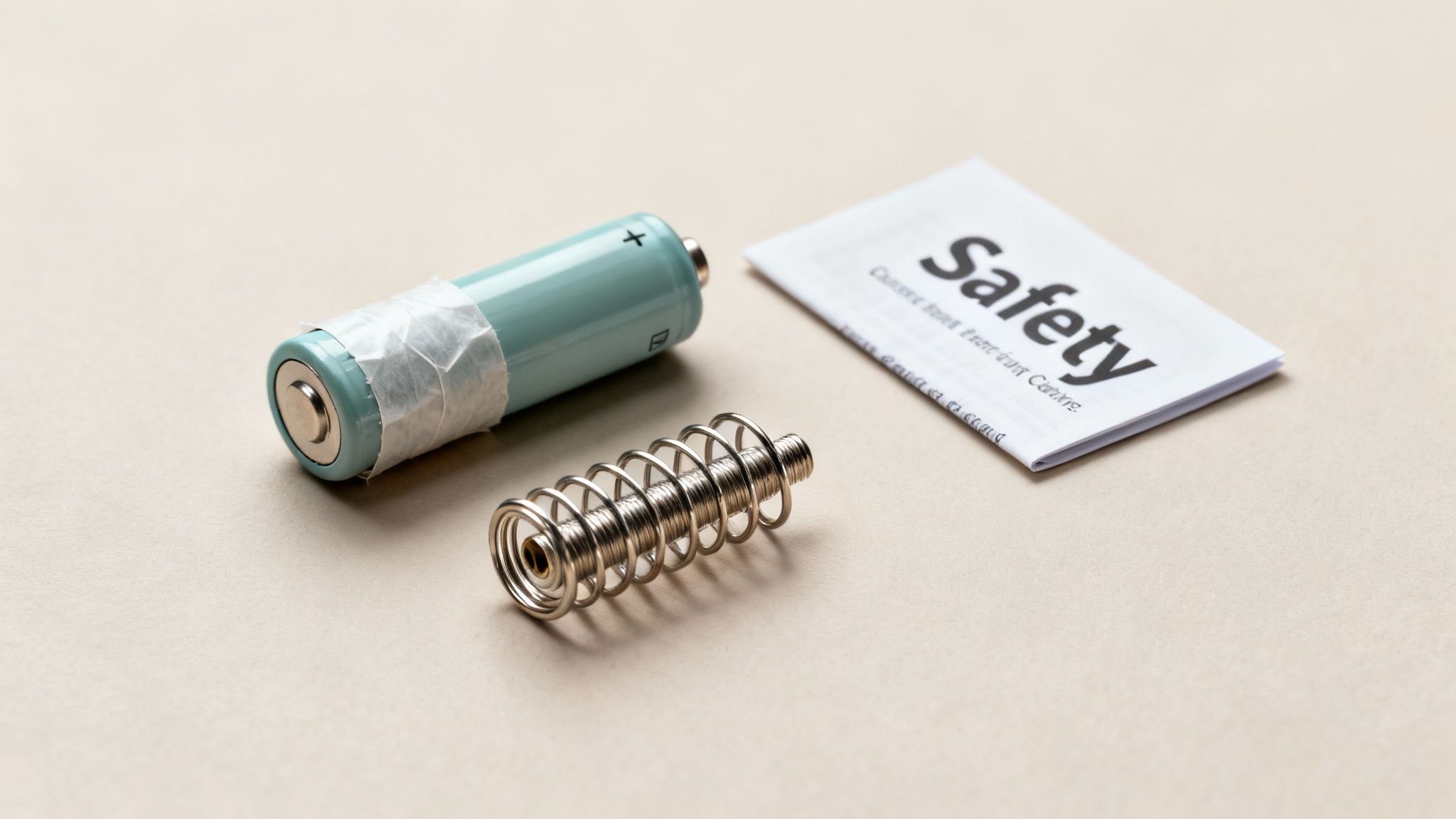
Matching Coils to Batteries
The key to a safe setup is synergy. Your battery and coil have to work together as a team. Always use batteries from reputable brands and know their Continuous Discharge Rating (CDR)—that’s the maximum current they can safely provide. If you're running a powerful sub-ohm setup, for example, you absolutely need a battery with a high CDR to handle the demand.
This isn't about scaring anyone; it's about building knowledge so you can enjoy vaping responsibly. For instance, knowing the specs for your favourite atomizers, like the popular Nord 4 coils, helps you pair them with the right power source from the get-go.
Safety First: Always inspect your battery wraps. If you see any nicks, tears, or peeling on the plastic covering, do not use the battery. It's a simple, cheap fix that prevents dangerous short circuits.
Using Your Device’s Protections
Thankfully, modern regulated vape mods come loaded with built-in safety features. These electronic safeguards are there to prevent common issues and protect both you and your device. Key protections to look for include:
- Short Circuit Protection: Instantly cuts power if a short is detected.
- Overcharge Protection: Stops the battery from charging once it hits full capacity.
- Low Resistance Protection: Prevents the device from firing if the coil's resistance is too low for it to handle safely.
Understanding these features means you can trust your device to do its job. Whether you're a seasoned vaper or just starting out, having a safe, reliable setup is everything. That's why our online shop offers tested, quality gear with convenient delivery right to your door in Calgary.
Finding the Right Vape Gear for Your Style
Armed with your new understanding of ohms, you’re ready to pick gear that actually matches how you like to vape. This isn’t about guessing anymore; it’s about making smart choices to build your perfect setup. Think of this as the bridge connecting the science of ohms to the products you see in our online shop.
Whether you're all about a tight, cigarette-like draw or you want to blow massive clouds, understanding resistance helps you navigate the options with confidence. Let's get practical.
Gear for the Flavour Chaser (MTL)
If you’re chasing a mouth-to-lung (MTL) experience that feels like a traditional cigarette and really brings out the subtle notes in your e-liquid, then a higher-resistance setup is your sweet spot.
- Coils: You’ll want to look for coils rated above 1.0 ohm. These coils sip power, produce a cooler vapour, and help your e-liquid and battery last a whole lot longer.
- Devices: Compact pod systems or classic vape pens are perfect for this style. They’re designed from the ground up to work well with the lower power needs of MTL coils.
- E-Liquids: E-liquids with higher PG (propylene glycol) or nicotine salts are a beautiful match. They deliver that satisfying throat hit and crisp, clean flavour you’re looking for.
Gear for the Cloud Enthusiast (DTL)
For those who live for big, warm clouds and a deep, direct-to-lung (DTL) inhale, a sub-ohm setup is exactly what you need.
Sub-ohm vaping demands powerful and reliable batteries to handle the increased current draw. Always pair your low-resistance coils with high-quality cells. For more details, explore our guide on selecting the best 18650 battery for your e-cig.
- Coils: Grab coils with a resistance below 1.0 ohm. These heat up incredibly fast to vaporize more e-liquid with every puff, which is the secret to those dense, satisfying clouds.
- Devices: You'll need a bit more muscle here—a more powerful mod or an advanced pod system that can push out higher wattage is essential.
- E-Liquids: High VG (vegetable glycerin) e-liquids are a must. The thicker consistency is what produces that thick, rich vapour and gives you a smoother hit at higher power levels.
Putting together the perfect combination is a breeze with our same-day vape delivery service in Calgary, letting you get the right gear without the wait.
Common Questions About Vaping and Ohms
Okay, we’ve covered the science behind ohms and how it all translates to your vape. But what does this mean for you day-to-day? Let's dive into some of the most common questions we hear from vapers.
Getting these practical details right is what separates a good vape experience from a frustrating one. Clear answers will help you troubleshoot problems and make smarter choices when you're browsing our online shop for new gear.
Can I Use Any E-liquid with a Sub-Ohm Coil?
While you technically could, you really, really don't want to. Sub-ohm devices are built to chuck massive clouds, which means you’re inhaling a whole lot more e-liquid with every puff. If you load up a high-nicotine e-liquid, that hit is going to feel incredibly harsh and overwhelming.
This is why most sub-ohm vapers stick to lower nicotine strengths, usually around 3-6mg, and pair them with high-VG (vegetable glycerin) e-liquids. The thicker consistency of high-VG juice is perfect for producing those dense, satisfying clouds and also helps prevent leaks in tanks designed for direct-to-lung vaping.
How Do I Know When to Change My Coil?
Your taste buds are your best guide here. If your go-to flavour suddenly tastes dull, "off," or you get that dreaded burnt taste even with a full tank, it’s a sure sign your coil is done.
Other dead giveaways include:
- A noticeable drop in the amount of vapour your device is producing.
- Your vape starts making weird gurgling or leaking sounds.
- The e-liquid in your tank looks much darker than usual.
On average, a coil will last you anywhere from one to two weeks. This all depends on how much you vape and what kind of e-liquid you use—super sweet juices are notorious for caramelizing on the coil and shortening its lifespan.
What Happens If My Coil's Resistance Is Too Low?
This is where safety becomes a huge deal, especially if you’re using an unregulated or mechanical mod. On any modern regulated device, a coil with resistance that's too low will trigger its built-in safety protections. You'll probably see an error message like "Atomizer Low" or "Check Atomizer," and the device will simply refuse to fire.
With an unregulated mod, however, there's no safety net. A dangerously low-resistance coil can force the battery to push out more current than it can safely handle. This is a recipe for disaster, potentially causing the battery to overheat, vent hot gas, or worse. Always, always know the safe limits of your device and your batteries.
Key Takeaway: The best flavour isn't always found at the highest wattage. Start low on your coil's recommended power range and slowly bump it up. You'll find that sweet spot where the warmth and flavour are perfectly balanced for your taste.
Understanding these common issues makes the whole vaping journey a lot smoother. It helps you dodge simple mistakes and truly get the most out of your gear. And when you're ready for new coils or a different setup, this knowledge makes finding the right products a breeze, especially with our fast vape delivery service in Calgary.
Find everything you need to perfect your vaping experience at Pouch Club. From the latest coils to premium e-liquids, we make it easy to get what you need with fast, reliable delivery. Browse our full selection at https://pouchclub.vip.