
Currently Empty: $0.00

Thinking about quitting tobacco for good can feel like a massive, overwhelming task. But it doesn't have to be. The secret isn't some magic bullet; it's about breaking the journey down into smaller, more manageable phases. This isn't about flipping a switch overnight. It's a process.
By focusing on one step at a time—getting ready, taking action, and then staying the course—you turn a huge challenge into a series of achievable wins. This approach helps you prepare mentally, line up your support system, and know what to expect, which dramatically boosts your chances of success.
Your Realistic Path to a Smoke-Free Life
Let’s be honest: quitting is tough. But having a clear, practical strategy makes all the difference. This is about creating a personalized plan that fits your life, from picking a quit date to figuring out which tools might help you crush those cravings when they hit.
Breaking Down the Quit Journey
Most successful quit journeys follow a similar path, broken into three distinct parts. You start by preparing your mind and your environment. Next, you move into the active phase of quitting. Finally, you shift your focus to maintaining that new smoke-free status for the long haul. This structure helps you anticipate what’s coming and celebrate your progress along the way.
The image below gives you a great visual of these key stages, showing the path from preparation to long-term success.
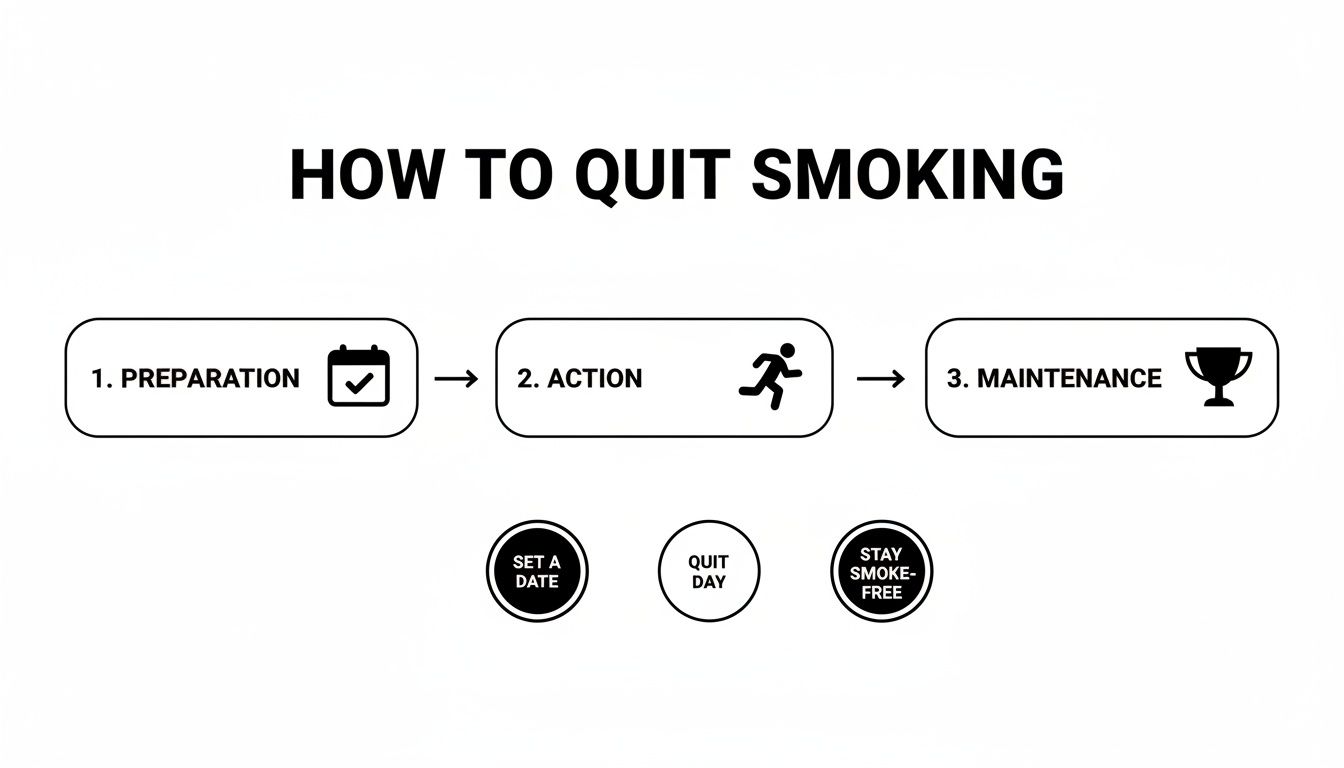
As you can see, each phase builds on the one before it. It’s a logical flow that helps you put your energy where it’s needed most at every point in your journey.
Modern Tools and Immediate Support
The good news is you have more tools at your disposal than ever before. Traditional options like nicotine replacement therapy (NRT) are still very effective, but there are also modern alternatives that offer new ways to manage cravings.
For example, tobacco-free nicotine pouches give you a discreet, smoke-free way to handle nicotine urges without the thousands of harmful chemicals that come from burning tobacco. For many, they’re a fantastic transitional tool on the path to becoming completely nicotine-free.
A huge plus for anyone in Calgary is getting support right when you need it. Our online shop offers same-day delivery in Calgary, meaning you can have aids like tobacco-free pouches in your hands the very day you decide you need them. No waiting, no delays—just immediate backup for when the challenge feels real.
To help you get started, here's a quick overview of what your plan will look like. You can use this as a reference as you move through each phase of your quit journey.
Your Quit Plan at a Glance
| Phase | Key Focus | Primary Goal |
|---|---|---|
| Preparation | Mindset, planning, and environment | Build a solid foundation and set a quit date. |
| Action | Managing cravings and withdrawal | Get through the first crucial days and weeks smoke-free. |
| Maintenance | Relapse prevention and lifestyle changes | Solidify new habits for a lasting, smoke-free future. |
Think of this guide as your practical companion. We’re going to walk through each of these phases in detail, offering actionable advice, real-world strategies, and info on all the tools available to you. Remember, this is about progress, not perfection.
Setting Yourself Up for Success Before Day One
A real attempt to quit smoking rarely happens on a whim. The hard work actually starts long before your official quit day, by building a solid foundation that can handle the challenges you're about to face. This is all about being strategic and turning a vague goal into a concrete plan.
This isn't just about willpower; it’s about getting to know your own habits on a much deeper level. By taking the time to prepare, you’re not just hoping for the best—you’re actively creating the conditions for success. It makes the whole journey feel a lot more manageable and way less intimidating.
Choose Your Quit Date Wisely
Picking a date to quit is a huge psychological step. It turns an abstract thought—"I should probably quit"—into a real commitment. Don't just pick a random Tuesday. Choose a date that's either meaningful or just plain smart from a logistics standpoint.
Maybe it's an anniversary, a birthday, or the first day of a new month. Some people find a low-stress day, like the start of a vacation, works best. Others do better with the routine of a normal work week. The key is to pick a date within the next two to four weeks. That gives you enough time to get ready without losing your momentum.
Once you've chosen it, mark it on your calendar. Tell a good friend. Make it real. This one action is your first big win and gets the whole process rolling.
Understand Your Smoking Triggers
You can't break a habit until you truly understand it. For most people, smoking is automatic—it's tied to specific routines, places, and feelings. Your next job is to become a detective of your own behaviour. For a few days, just keep a simple log.
Every time you light up, note a few things:
- When was it? (e.g., first thing in the morning, on your coffee break)
- Where were you? (e.g., in the car, on the back deck)
- Who were you with? (e.g., by yourself, with a specific coworker)
- How were you feeling? (e.g., stressed, bored, happy, tired)
This simple audit will shine a light on your personal smoking patterns. Maybe your biggest trigger is that first coffee, the drive home from work, or feeling stressed after a tough meeting. Identifying these high-risk moments is everything, because it lets you create a plan to deal with them before they even happen. It's a proactive approach that is the cornerstone of quitting for good.
Assemble Your Quit Smoking Toolkit
You wouldn't start a big project without the right tools, and quitting is no different. Having support systems and aids ready to go is absolutely essential. Think of this as your personal support crew, ready to be deployed the second you need them.
Your toolkit should have a mix of strategies and products that fit your needs. This could mean traditional nicotine replacement therapies (NRT) like patches or gum. It also includes modern, smoke-free alternatives that can help you manage cravings without the combustion.
For many, tobacco-free nicotine pouches are an incredibly valuable tool. They are discreet, spit-free, and deliver nicotine quickly to get you through an intense urge, all while helping you break the physical hand-to-mouth habit of smoking. Exploring the different nicotine strengths in products like ZONNIC can help you find the right level of support. You can learn more about using them effectively by checking out our guide on ZONNIC pouches in Canada.
For anyone in Calgary, planning is even easier. Our online shop offers same-day delivery throughout Calgary on a huge range of products. This means you can have your entire toolkit delivered right to your door, making sure you're fully equipped for your quit date without any last-minute stress.
Build Your Human Support System
Quitting isn't something you have to do alone. In fact, study after study shows that a strong support network dramatically increases your chances of success. Now is the time to have some honest conversations with the important people in your life.
Tell your family, friends, and coworkers about your plan and your quit date. Be specific about the kind of support you need. For example, you could ask a friend to be your go-to person for a quick call when a craving hits, or ask your partner for extra patience during the first couple of tough weeks.
This level of preparation is what separates a fleeting attempt from a lasting change. Public health efforts have shown incredible results over time. For instance, California’s adult cigarette smoking prevalence has dropped to about 8.5%—a massive decline that proves the power of combining personal commitment with strong support systems.
With your date set, your triggers identified, your tools ready, and your support system in place, you are no longer just wishing to quit. You have a plan.
Navigating Cravings and Nicotine Withdrawal
The first few days and weeks after you quit are, without a doubt, the toughest. This is when your body is scrambling to adjust to a life without nicotine, and the withdrawal symptoms can feel pretty intense. But here’s the thing: understanding these challenges is the first step to beating them. Withdrawal is very real, but it’s also temporary and, most importantly, totally manageable with the right game plan.
Everyone’s journey through withdrawal is a bit different, but most people report feeling irritable, having trouble concentrating, feeling anxious, and, of course, getting hit with powerful cravings. These feelings aren’t a sign of weakness—they’re a sign that your body is healing and resetting itself. Thinking of it that way can shift your whole perspective from a struggle to a positive sign of progress.
Understanding and Outsmarting Cravings
Cravings feel massive, but they're surprisingly short. Most urges to smoke last only three to five minutes. Your entire job in that moment is just to get through that tiny window of time without lighting up. This is where having a clear, immediate action plan becomes your secret weapon.
Instead of trying to brute-force your way through a craving with willpower—which is exhausting—the goal is to distract and redirect your mind and body until it passes. One of the most effective and easy-to-remember methods is the "Four Ds" technique. It gives you a simple, structured response for when a craving strikes.
- Delay: Before you do anything, tell yourself to wait just 10 more minutes. That small pause is often enough for the worst of the urge to fade.
- Deep Breathe: Take a few slow, deep breaths. Breathe in through your nose for four counts, hold it, then exhale slowly through your mouth. It’s calming, and it actually mimics the breathing pattern you used when you smoked.
- Drink Water: Sip a glass of cold water. This helps with the hand-to-mouth habit and can help flush out any lingering nicotine.
- Do Something Else: Change your activity immediately. Get up and walk around, throw on a favourite song, do a quick puzzle, or text a friend. Shifting your focus is a powerful way to break the mental loop a craving traps you in.
Having this simple toolkit ready means you'll know exactly what to do when an urge hits, turning a moment of panic into a moment of control.
Leveraging Immediate Support for Tough Moments
While behavioural tricks are crucial, sometimes you need more immediate relief to get through a powerful craving. This is where having the right cessation aids on hand can be a real game-changer, acting as a critical safety net. The key is to find what works for you and make sure you have it nearby when you need it most.
Fast-acting options can be especially helpful for those sudden, overwhelming urges. Tobacco-free nicotine pouches, for example, are designed to deliver nicotine quickly and discreetly. They can satisfy a craving without the smoke, vapour, or harmful chemicals that come with combustible tobacco, giving you the immediate relief needed to ride out a tough moment and stay on track.
For anyone learning how to quit smoking tobacco in Calgary, this kind of support is more accessible than ever. Our online shop offers same-day delivery, ensuring you’re never caught unprepared. If you feel a rough day coming on, you can order what you need from our online shop and have it delivered right to your door in Calgary, giving you instant backup when it matters most.
Knowing that immediate support is just a click away removes a huge layer of anxiety from the quitting process. It means you can build a solid plan knowing you have fast, reliable access to the tools that will help you succeed.
Physical and Mental Withdrawal Symptoms
Beyond cravings, you'll likely run into other withdrawal symptoms as your body adjusts. It helps to know what to expect so you can prepare.
Common Physical Symptoms:
- Headaches and dizziness
- Increased appetite
- Feeling tired or having trouble sleeping
- Coughing as your lungs start to clear out
Common Mental and Emotional Symptoms:
- Irritability and restlessness
- Anxiety or feeling a bit down
- Difficulty concentrating
These symptoms usually hit their peak within the first week and then slowly fade over the next few weeks. Just remember, they are temporary signs of your body healing. Stay hydrated, try to get some light exercise, and be patient with yourself during this phase. Every single day you get through is a major win.
Exploring Tobacco-Free Nicotine Alternatives
Let’s be honest: quitting smoking is a two-headed monster. You’re not just fighting a chemical dependence on nicotine; you’re also trying to break years of ingrained habits and rituals. The morning coffee cigarette, the after-dinner smoke, the one you grab under stress—these are tough patterns to dismantle. This is where modern alternatives can be a game-changer, giving you a way to manage cravings without the destructive act of lighting up.
These tools work by separating the nicotine your body is wired to expect from the harmful act of smoking. Instead of inhaling thousands of chemicals from burning tobacco, you get a clean, controlled dose of nicotine. This simple switch lets you focus all your energy on breaking the behavioural chains first, which is often the bigger battle.
What Are Tobacco-Free Nicotine Pouches?
One of the most effective modern tools is the tobacco-free nicotine pouch. You’ve probably seen them around. They’re small, discreet pouches filled with synthetic nicotine and food-grade ingredients—no tobacco leaf in sight. You just tuck one between your gum and upper lip, and the nicotine is absorbed, satisfying your craving without any smoke, vapour, or mess.
For someone trying to quit, this approach has some serious advantages:
- Completely Smoke-Free: This is the big one. You eliminate the thousands of toxic chemicals that come from burning tobacco.
- Discreet and Odourless: You can use them absolutely anywhere—at work, in a restaurant, on a plane—without anyone knowing. There’s no smell and nothing to see.
- Controlled Nicotine Delivery: Pouches come in different strengths, so you are in complete control of your intake.
The idea isn’t to swap one addiction for another forever. Think of these pouches as a powerful transitional tool—a bridge to get you through the roughest patches of withdrawal while you build a new, smoke-free life. You can dig deeper into this topic in our guide on whether nicotine pouches are safer than traditional tobacco products.
Integrating Pouches into Your Quit Plan
Using nicotine pouches effectively is all about strategy. They aren’t a magic bullet, but they are an incredible support tool for those high-risk moments when willpower alone feels like it’s about to snap. They’re your safety net when a craving hits you like a ton of bricks.
Here’s a real-world example: say your drive home from work is a massive trigger. Instead of white-knuckling it the whole way, you could pop in a pouch a few minutes before you leave the office. This preemptive strike satisfies the craving before it takes hold, letting you get home without that intense mental fight.
The real power here is flexibility. It gives you an immediate, effective way to shut down cravings, which builds your confidence and proves you can get through those moments without a cigarette. It’s about being prepared, not just being stubborn.
As you get further along in your quit journey, the goal is to lean on them less and less. You might start by only using them during your top three trigger situations. Over time, you can taper down the nicotine strength until you don’t need them at all. It’s a clear, structured path toward being completely nicotine-free.
Immediate Support When You Need It Most
When the motivation to quit strikes, it’s often a sudden, powerful feeling. The last thing you want is to be stuck waiting for your quit tools to arrive while that motivation fades and the cravings kick in. This is especially true in the first few days, which are notoriously the hardest.
For anyone in Calgary, we’ve made this part easy. Our online shop offers same-day delivery in Calgary on a huge range of tobacco-free nicotine pouches. That means you can make the decision to quit this morning and have the support you need in your hands by this afternoon.
This instant access removes a huge barrier to getting started. It equips you to handle urges from the very first hour of your new smoke-free life and provides peace of mind knowing that if you hit a wall, backup is just a few clicks away. We know how vital this kind of accessible support is. Well-funded public health programs, like California’s highly-rated cessation services, have shown time and again that robust, easy-to-access support systems are key to helping people quit for good. You can read more about the impact of state-funded cessation programs at Lung.org.
Building Your New Smoke-Free Lifestyle
Successfully quitting smoking isn’t just about surviving the first few weeks; it's about fundamentally redesigning your life without cigarettes. This is where you shift your focus from simply "not smoking" to truly thriving as a non-smoker. It’s about building resilience until being smoke-free becomes your new normal, not a constant battle.
This transition means learning how to navigate the world without your old coping mechanism. You'll have to face down high-risk situations like social gatherings, stressful workdays, and moments of boredom with a new set of tools. This is where all those short-term wins start turning into long-term, life-changing habits.
Handling Tricky Social Situations
Social events can feel like a minefield when you're newly smoke-free. Your friends might still light up, and the familiar sight and smell can trigger powerful urges. The key isn't to become a hermit—it's to go in with a solid game plan.
Before you even head out, rehearse what you'll say when someone offers you a cigarette. A simple, confident, "No thanks, I've quit" is usually all you need. You don't owe anyone a lengthy explanation.
Also, have an exit strategy. If the cravings get too intense, it is perfectly okay to leave early. Your health and your commitment to quitting come first. I promise, these situations get so much easier to handle over time.
Finding New Coping Mechanisms
For years, a cigarette was likely your go-to solution for everything from stress to boredom. Now, it's time to build a new, healthier toolkit. The goal is to find activities that give you a similar sense of relief or distraction, but without the devastating health consequences.
Think about what smoking actually did for you, then find a solid replacement:
- For Stress Relief: Instead of a smoke break, try a five-minute walk around the block, a few deep breathing exercises, or just putting on a song that calms you down.
- To Combat Boredom: Find a new hobby you can do with your hands. Think sketching, playing an instrument, or tackling a new puzzle.
- As a Reward: Celebrate the end of a long day with a cup of specialty tea, a chapter in a good book, or a quick call with a friend you haven't spoken to in a while.
This isn't just about distracting yourself. It’s about consciously creating new, positive routines to fill the void that smoking left behind. That deliberate effort is what solidifies your new smoke-free life.
Celebrate Every Milestone
Quitting is a marathon, not a sprint, and you have to celebrate your progress along the way. Acknowledging your milestones—whether it's one day, one week, or one year—is a powerful way to keep your motivation high.
Don't underestimate the power of small rewards. When you hit a goal, treat yourself to something you enjoy that has nothing to do with smoking. It could be a nice meal out, a new gadget, or simply taking an afternoon off to relax. This reinforces the positive changes you're making and reminds you of how far you've come.
These celebrations help rewire your brain to associate quitting with positive feelings, making it that much easier to stay on track for good.
Calgary-Specific Support for Your Journey
Building this new life is much easier when you have support. Here in Calgary, there are some fantastic local resources you can lean on. Alberta Health Services offers programs and counselling specifically designed to help people quit tobacco for good.
Prevention is also a huge part of the public health picture. For instance, in places like California with strong public health initiatives, strategies are constantly evolving to address youth smoking, as roughly 31,600 kids under 18 try their first cigarette each year. You can find some valuable insights into these prevention and quitting dynamics by exploring tobacco use trends and their impact at tobaccofreekids.org.
Remember, you're not just kicking a bad habit. You're building a healthier, more resilient version of yourself. Every craving you beat and every new coping skill you learn is another brick in the foundation of your new smoke-free life.
Common Questions About Quitting Tobacco
As you start your journey to ditch tobacco, you're bound to have questions pop up. Getting straight, clear answers can be the difference between pushing through a tough moment and feeling like you want to give up. This section is designed to tackle the most common hurdles people face with practical advice for real-world situations.
Think of it as your go-to guide for those moments when you need clarity, fast.
How Do I Handle a Sudden Intense Craving?
When a powerful, out-of-the-blue craving hits, it can feel like a tidal wave. The secret is having an immediate action plan ready before it even happens.
Your best bet is instant distraction. A simple but incredibly effective trick is the 'Four Ds'—Delay for 10 minutes, take some Deep breaths, Drink a glass of water, and Do something else. Anything else. This technique works because it snaps you out of that obsessive mental loop.
Sometimes, though, distraction alone doesn't cut it. That's when a fast-acting tool can be a real game-changer. A tobacco-free nicotine pouch, for instance, can satisfy the physical urge in minutes without sending you back to square one.
Knowing you have a safety net is a huge psychological advantage. For anyone in Calgary, our online shop offers same-day delivery, so you’re never caught unprepared. You can get the support you need delivered from our online shop right to your door in Calgary, exactly when you need it most.
How Long Will Nicotine Withdrawal Last?
This is the big one, and honestly, it’s a bit different for everyone. Typically, the toughest physical symptoms of nicotine withdrawal—think irritability, headaches, and that foggy feeling—tend to peak within the first three to four days. After about a week, you'll notice them start to fade significantly.
The mental side of things, those psychological cravings, can stick around a bit longer. They're usually tied to old habits and triggers you’ve built over the years, like that morning coffee or after-dinner smoke. That’s why building new routines is just as crucial as getting through that initial physical hump. Be patient with yourself; every single day you stay smoke-free is a win.
I Slipped Up and Smoked. Does That Mean I Failed?
Absolutely not. Let’s get that straight. A slip-up is a totally normal part of the process for so many people. It’s a learning experience, not a failure. What really matters is what you do next. Don't let one cigarette become an excuse to throw in the towel.
Instead, use it as data. Step back for a second and figure out what triggered it. Were you stressed? Out with certain friends? In a specific place? Use that insight to make your plan stronger for the next time you're in that situation. Forgive yourself, get right back on your smoke-free goal, and remind yourself of all the reasons you wanted to quit in the first place.
Many find that having a transitional tool on hand helps manage these high-risk moments. While tobacco-free pouches can be a huge help, it's smart to know how they work. To learn more about using them as a quitting aid, check out our article on the potential side effects of tobacco-free pouches.
At the end of the day, one cigarette doesn't erase all the progress you've made. Real success is measured by how quickly you get back on track.
Ready to take the next step with a modern, smoke-free alternative? Pouch Club offers a wide selection of premium tobacco-free nicotine pouches with convenient same-day delivery in Calgary. Find the support you need to succeed at https://pouchclub.vip.