


Total: $51.97
Thinking you can buy cigarettes at the same age everywhere in Canada? It’s a common mistake. The truth is, the legal age to buy cigarettes in Canada isn’t a single, straightforward number. While the federal government sets a baseline, each province and territory gets the final say, often making the rules stricter.
This means your legal age depends entirely on where you are.

Trying to figure out the rules for buying tobacco in Canada can feel like navigating a maze without a map. There’s no single, nationwide age limit. Instead, the country operates under a dual-law system where federal legislation provides a floor, but provincial and territorial governments have the power to raise it.
This setup creates a patchwork of regulations across the country. The federal Tobacco and Vaping Products Act sets the absolute minimum legal age at 18 years old. But think of that as just the starting point—most provinces have used their authority to set the age higher, aiming to curb youth access to tobacco and nicotine products.
Because of this provincial authority, you'll generally find three different age requirements depending on where you are:
This variation means the rules in Calgary are different from those in Toronto or Charlottetown. Your ability to legally purchase cigarettes or other nicotine products is determined by your specific location, not a universal Canadian law.
So, why the difference? It all comes down to public health. Provinces have the power to create laws that address their own regional health concerns. This isn't a new concept—the federal Tobacco Restraint Act of 1908 first made it illegal to sell tobacco to anyone under 16, but that baseline has evolved significantly over the last century.
Today, a province like Alberta sets its legal age at 18, making it one of the more lenient regions. This is a crucial detail for residents in Calgary, where our online shop Pouch Club offers same-day delivery of tobacco-free alternatives like ZYN or VELO nicotine pouches to adults. You can discover more insights about the history of Canadian tobacco laws to see just how much things have changed. This system allows each jurisdiction to respond directly to local health trends and smoking rates.
Today’s web of smoking age laws didn't just pop up out of nowhere. Their roots go back more than a century, tracking a slow but steady rise in public health awareness and government action aimed at protecting young Canadians. The journey actually started long before modern health campaigns, with individual provinces taking the first stabs at limiting youth access to tobacco.
This whole legislative story kicks off in the late 1800s. Even back then, people were starting to agree that selling tobacco to kids was a problem. These early provincial efforts set the stage for federal action, creating a foundation that national regulations would build on decades later.
Canada's first big federal law on the topic was the Tobacco Restraint Act of 1908. This landmark act made it a federal crime to sell tobacco products to anyone under the age of 16. While 16 seems shockingly young by today’s standards, it was a massive step for its time, establishing a national baseline for the very first time.
For decades, that age limit was the federal standard. But as medical evidence piled up throughout the 20th century, proving the serious health risks of smoking, public and government attitudes began to change—big time. The connection between tobacco and diseases like lung cancer and heart disease became impossible to ignore, kicking off a whole new wave of legislative change.
The evolution of Canada's cigarette purchase age tells a story of steady hikes to protect youth. It started with provinces like British Columbia banning sales to minors in 1891 and continued as awareness of tobacco's toll grew—a 1961 Health Canada study revealed 60% higher death rates among smokers from lung cancer and heart disease.
All this mounting evidence set the stage for a major update. In 1993, the government passed the Tobacco Sales to Young Persons Act, officially raising the federal minimum legal age to buy cigarettes in Canada from 16 to 18. This law was a direct response to the overwhelming proof of tobacco's dangers and the urgent need for stronger protections for teens.
The 1993 Act was a real turning point, signaling a much more assertive approach to tobacco control. By 1994, provinces like Alberta had locked in 18 as their minimum age, a standard that remains in Calgary today, where online shops like Pouch Club offer delivery of tobacco-free alternatives to adults. You can explore the history of Canada's legal smoking age to see a full timeline of how these provincial and federal laws developed.
Understanding this history is key to seeing why our system works the way it does now. Every legislative step, from the first provincial bans to the federal minimum of 18, was a reaction to a deeper understanding of public health. It’s a story of constantly raising the bar to shield young people from nicotine addiction—a principle that still guides tobacco policy today.
While the federal government sets a baseline, the real answer to the legal age to buy cigarettes in Canada is decided at the provincial and territorial level. Each jurisdiction gets the final say, which creates a patchwork of rules where the legal age can change just by crossing a border.
This breakdown will help you quickly figure out the specific age requirement where you live.
The chart below shows just how much the federal minimum age for tobacco has shifted over the last century, reflecting a growing awareness of public health.
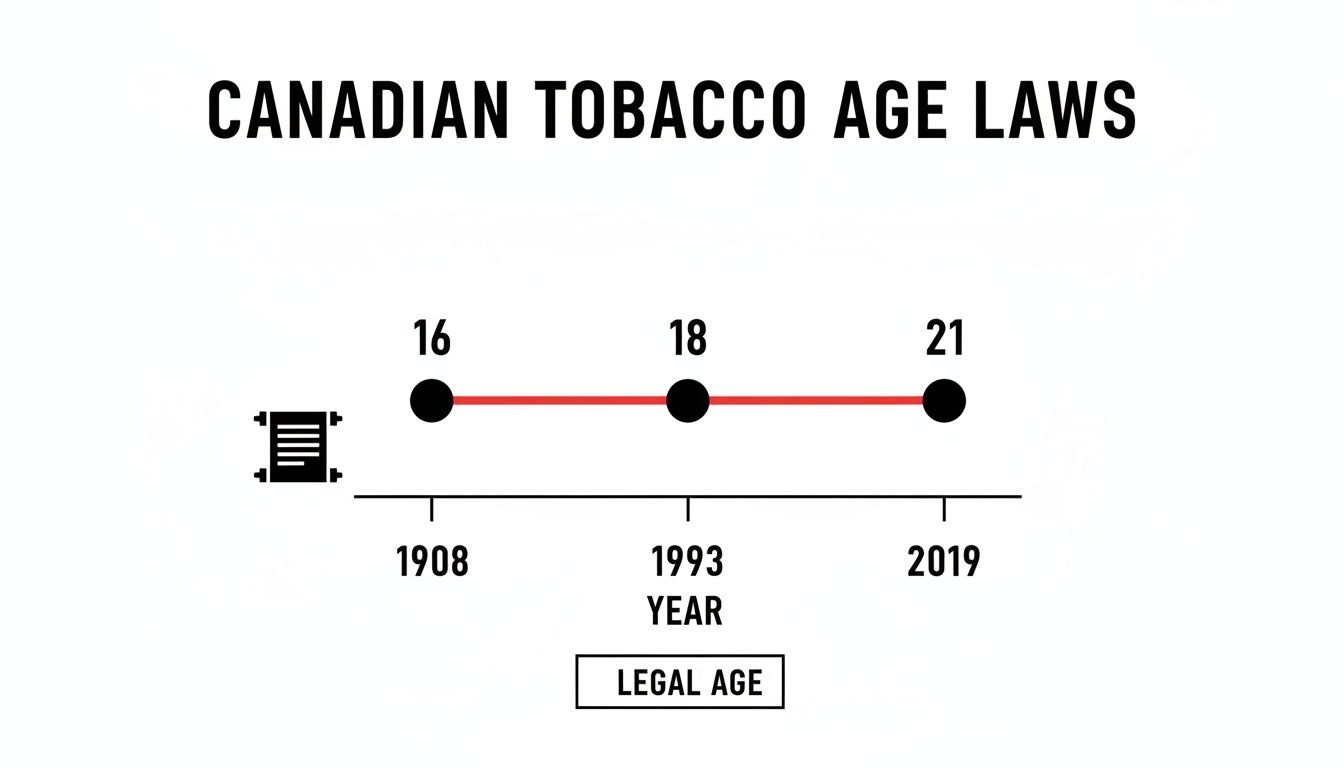
You can clearly see the steady climb, from 16 way back in 1908 to the introduction of 21 in some regions by 2019. It’s a story of Canada’s long-term commitment to keeping tobacco away from young people.
Most of Canada has landed on 19 as the magic number, but a couple of provinces do things differently. Alberta, along with Saskatchewan, Manitoba, and Quebec, sticks to the federal minimum of 18. This is crucial information for adults in places like Calgary, who can legally buy tobacco products or use delivery services from an online shop for tobacco-free options like nicotine pouches.
On the complete opposite end of the spectrum is Prince Edward Island. Back in 2019, PEI made a bold public health move by raising its legal age to 21—the highest in the entire country. The logic was simple: create a real barrier to stop high school students from getting cigarettes and vapes from their slightly older friends.
The most common legal age you'll find across Canada is 19. A solid majority of provinces and territories have adopted this standard, creating a fairly consistent rule for a huge portion of the country's population.
Here are the places where you must be 19 or older to buy cigarettes, vapes, and other nicotine products:
Adopting the age-19 rule is a collective effort to push tobacco products further out of reach for teenagers. These rules also cover newer products hitting the market. For more on that, you can read our guide on when Zonnic will be available in Canada and how age restrictions will apply.
By setting the minimum age at 19, these provinces create a "social buffer." It makes it much harder for high school students to ask older friends to buy for them, which effectively cuts off a common supply line for underage smoking. This approach really targets the social dynamics of how young people get access to tobacco.
Shopping for nicotine products online might seem like it exists in a different world, but it brings a whole new set of rules to the table. While the convenience is undeniable, Canadian law is crystal clear on one thing: the same age restrictions that apply in a physical store also apply online.
This means that no matter where you live, the legal age to buy cigarettes in Canada for your province or territory is the same whether you’re clicking "add to cart" or standing at a counter.
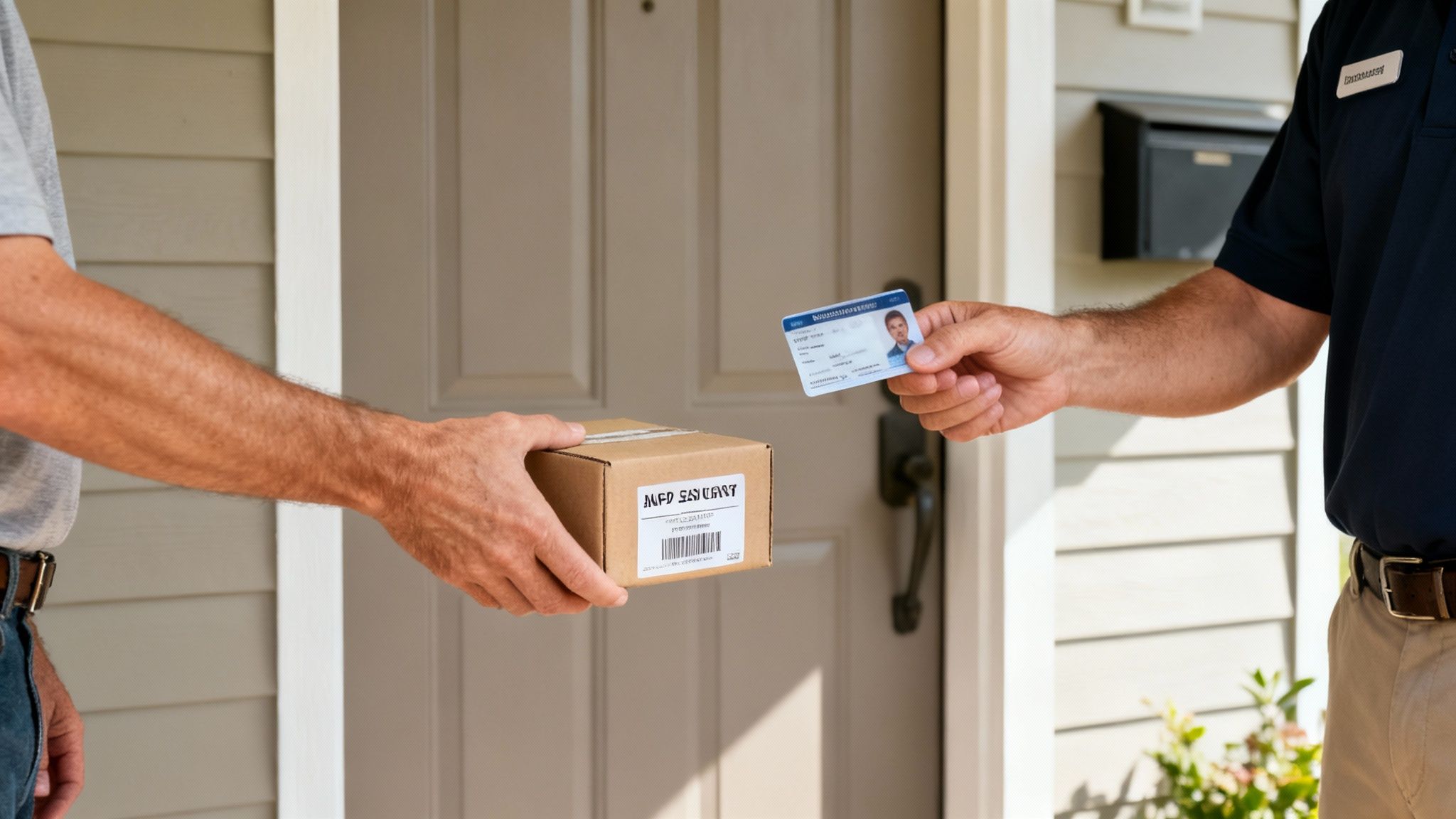
To make this happen, reputable online sellers use serious age verification systems—and we’re not talking about a simple checkbox asking if you're old enough. The process is a two-step checkpoint designed to stop sales to minors at every stage, from the moment you place your order to the second it arrives at your door.
Think of buying nicotine products online like getting into a licensed venue. You have to show your ID to the bouncer at the entrance (checkout), and if you look young, you might get carded again at the bar (delivery). It’s a system with multiple checks to ensure everyone is playing by the rules.
Here’s a breakdown of how it works for legitimate online retailers:
This dual-layer system isn’t just good business practice; it's a legal requirement designed to keep nicotine products out of the hands of minors.
So, how do companies manage to offer speedy services like same-day delivery while sticking to these strict rules? Let's take a real-world look at Pouch Club, a Calgary-based online shop that specializes in tobacco-free nicotine pouches.
In Alberta, the legal age is 18. Pouch Club builds age verification right into its business model. When a customer in Calgary places an order for same-day delivery, they know the final part of the transaction happens right at their doorstep.
The delivery driver becomes the final gatekeeper, with the responsibility to physically check the customer's ID and confirm they are 18 or older.
This on-the-spot ID check is the key to balancing convenience with responsibility. It allows adults in Calgary to enjoy rapid delivery from an online shop while ensuring the business fully complies with provincial law, demonstrating that quick service and legal adherence can go hand-in-hand.
This model shows exactly how responsible online retailers operate within Canada's legal framework. Similar rules apply to vaping products, too. To learn more, check out our guide on the e-cigarette legal age in Canada and see how it mirrors traditional tobacco laws.
Ultimately, these verification steps are non-negotiable for any legitimate online nicotine seller in the country.
With all these different laws across the country, it’s fair to ask a simple question: do they actually work? Looking at decades of public health data, the answer is a clear and resounding yes. The strict rules around the legal age to buy cigarettes in Canada have been one of the biggest reasons for the massive drop in youth smoking rates nationwide.
These laws do more than just require an ID check at the counter. They create a powerful "social barrier." Think about it—when the legal age is 18 or 19, it becomes a lot harder for a 15- or 16-year-old to ask a slightly older friend to buy cigarettes for them. Disrupting this social supply chain is one of the smartest and most effective parts of age-restriction policies.
The statistics really tell the story. Over the last two decades, smoking rates among Canadian teenagers have absolutely plummeted. National health surveys show that regular smoking among 15- to 19-year-olds dropped from over 20% at the turn of the millennium to just low single digits today. That’s not a small dip; it's a huge public health victory.
This trend is obvious in places like Alberta, where the age is 18. While an adult in Calgary can get same-day delivery of tobacco-free ZYN or EGP pouches from an online shop, the laws have been incredibly effective at blocking youth access to traditional cigarettes. For example, the 2012 Canadian Tobacco Use Monitoring Survey was a major milestone, showing smoking rates for 15- to 19-year-olds had hit a record low of 11%—a massive drop from 22% in 2001. By 2020, regular smoking in that same age group had fallen to just 3%. You can dig into the historical youth smoking statistics on Canada.ca for more details.
The data is clear: raising the legal purchase age directly correlates with fewer young people starting to smoke. By making tobacco products harder to obtain during the critical teenage years, these laws prevent many from ever developing a lifelong nicotine addiction.
This positive trend shows how a smart, multi-layered approach—combining legal age limits with public awareness campaigns—really works. For those who did start smoking and are now looking for a way out, understanding the journey is the first step. You might find our guide on how to quit smoking tobacco helpful for practical tips and support. Ultimately, the sustained drop in youth smoking proves that thoughtful, data-driven laws can build a healthier future for the next generation.
Knowing the legal age to buy cigarettes in Canada is one thing, but understanding why those laws are enforced so aggressively is another story. For retailers, the stakes are incredibly high when it comes to selling tobacco or nicotine products to anyone underage. The penalties are designed to be severe enough to make sure every business—from the corner convenience store to an online vape shop offering delivery in Calgary—puts age verification first.
Failing to check for ID isn't just a minor slip-up. The consequences can escalate quickly and threaten a business's very existence.
The most direct hit for selling to a minor is a hefty fine. For a first offence, these fines can easily run into the thousands of dollars, varying by province. If it happens again, the financial penalties get even steeper, creating a powerful reason for stores to be vigilant.
But it goes beyond just money. Retailers risk their ability to operate at all. Provincial authorities can take actions that include:
This tiered system of punishment ensures that businesses feel the pressure to follow the law from the very first mistake.
Authorities don't just sit back and wait for someone to report a violation. They actively monitor stores through government inspections and "sting" operations. These checks often involve sending supervised underage individuals into a shop to try and buy tobacco or vape products.
These enforcement actions are a constant reminder to retailers that the risk of getting caught is very real. For a legitimate online shop offering delivery in Calgary, this means rigorous ID checks at the door aren’t just good policy—they’re essential for survival.
The serious risks involved explain why legitimate sellers are so strict about checking ID. The potential cost of a single mistake is simply too great to ignore.
Of course. Here is the rewritten section, crafted to sound like it was written by a human expert, following all the specified requirements.
Even with the rules laid out, it's natural to have questions, especially when it comes to situations that aren't so black and white. Let's clear up some of the most common grey areas people ask about.
One of the biggest points of confusion is whether the age rules apply to products that aren't traditional cigarettes. The answer is a clear and simple yes.
Canadian laws have expanded over the years to keep up with the market. Today, the rules that govern tobacco sales also cover all vaping products and other items containing nicotine, like nicotine pouches. So, whether you're buying from an online shop that offers delivery in Calgary or walking into a local store, you must meet your province's minimum age to purchase any of these.
It's also completely illegal across Canada to buy tobacco or vape products for someone who is underage. This is often called "proxy purchasing," and it comes with steep penalties. Both the person who buys the products and the retailer who sells them can face significant fines.
The laws aren't just for retailers—they apply to buyers, too. Trying to get around the age restrictions is a serious matter with real consequences.
Using a fake ID to buy cigarettes, vapes, or pouches is a criminal offence. If you're caught, you could be looking at fines and even charges for possessing fraudulent identification. Retailers are trained to spot fake IDs, and they're legally required to refuse the sale if they have any doubts.
It's important to remember that the laws are primarily focused on the minimum age to purchase tobacco and nicotine products. While some places might have separate rules about possession, the main goal of the legislation is to stop youth from getting access at the point of sale.
This is exactly why retailers, both in-person and online, are so strict about checking ID before they hand over any age-restricted product. They're not just following store policy; they're following the law.
For adults in Calgary looking for a convenient, smoke-free alternative, Pouch Club offers same-day delivery on a wide selection of premium nicotine pouches. Explore top brands like ZYN and VELO and get your order fast. Visit us at https://pouchclub.vip to see our current selection.